Face Recognition and Vector Database Integration
Overview
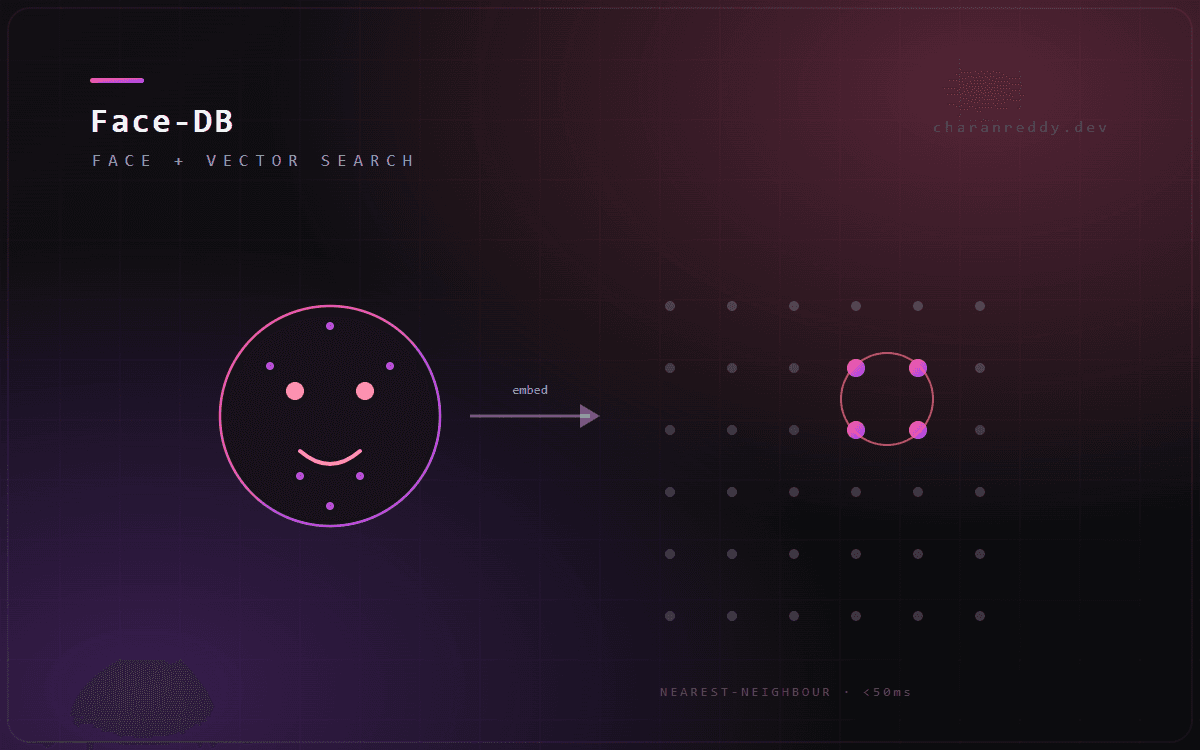
Most face-recognition tutorials stop at "is this Person A?" I wanted the part that actually matters in production: where do the faces live, and how fast can you find one among thousands? This project encodes each face into a 128-dimension embedding and stores it in a vector database, so recognition becomes a nearest-neighbour search instead of a brute-force comparison. It exposes a clean CRUD API over identities and runs against ChromaDB locally or Pinecone in the cloud — the same code, swapped with a single environment variable.
Tech Stack
Challenges
- Keeping recognition accurate across the messy real world — bad lighting, odd angles, partial faces.
- Staying fast as the gallery grows: a linear scan that's fine for 50 faces falls over at 50,000.
- Designing one interface that behaves identically over a local store (ChromaDB) and a managed cloud store (Pinecone).
- Managing API keys and credentials without ever hard-coding a secret.
Solution
Faces are embedded with the `face_recognition` library (dlib under the hood) and stored as vectors, so identification becomes an approximate-nearest-neighbour query — sub-linear and cheap. A thin abstraction layer hides the backend, making ChromaDB and Pinecone interchangeable, and credentials come from environment variables only. The whole thing is covered by `unittest` and wired to GitHub Actions, which runs the suite across Python versions and operating systems on every push.
Outcome
The result is a recognition backend you can actually drop into something bigger: identities go in and come back by similarity in milliseconds, the storage layer is swappable, and CI keeps it honest. Moving from local prototyping (ChromaDB) to scalable cloud search (Pinecone) is a config change, not a rewrite.
What I'd do differently
I'd add a proper embedding-versioning story. Today, changing the face-encoding model means re-embedding everyone; next time I'd store the model version alongside each vector and support a background re-index, so upgrading the model never means downtime.