Forge: The AI Ops Platform That Repairs Its Own Workflows
Overview
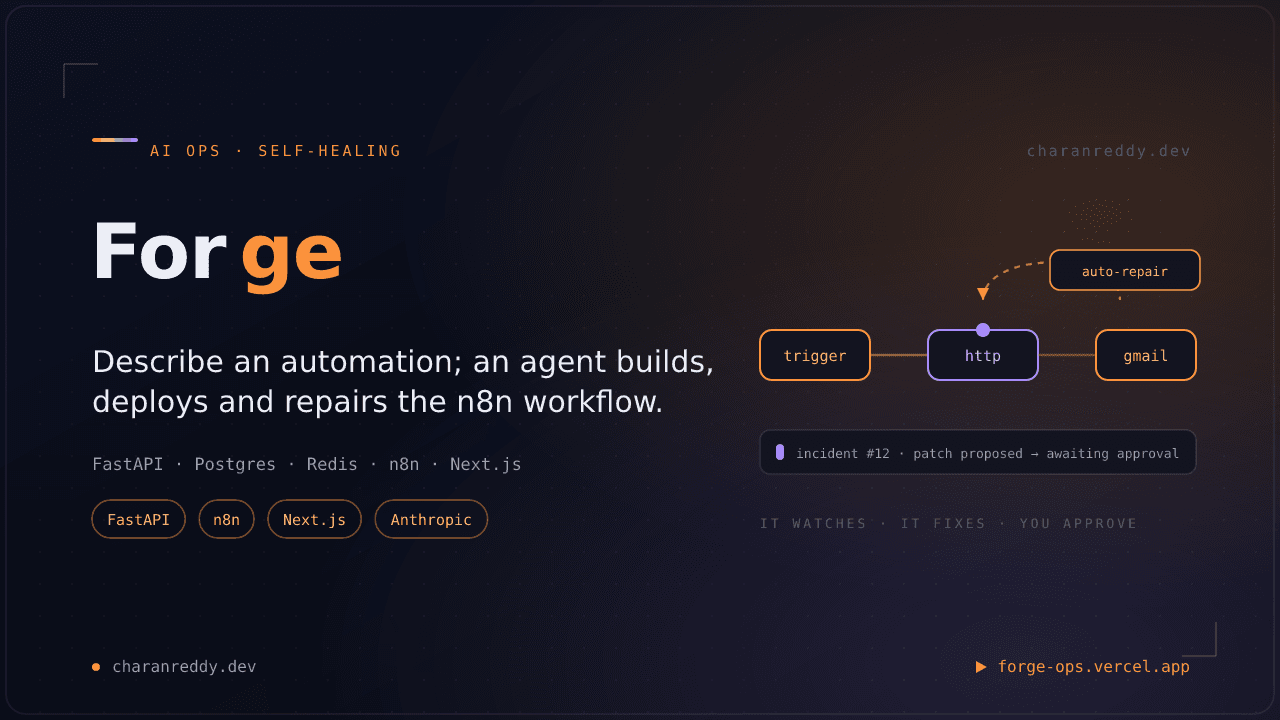
Automation platforms run the workflow you give them and stop there — when a step breaks at 3am, it just stays broken until someone notices. Forge closes that loop. You describe the automation ("watch for ML job postings daily and draft cold emails"); an agent layer turns it into a schema-valid n8n workflow, deploys it as an immutable version, and monitors every run. When one fails, a diagnostic agent reads the logs, does a root-cause analysis, and either auto-repairs the workflow or files a human-readable incident with a proposed patch.
Tech Stack
Challenges
- Turning a plain-English request into workflow JSON that n8n will actually accept — node types that exist, connections that resolve, credentials referenced correctly.
- Letting an agent modify production automations without ever making a silently destructive change.
- Keeping LLM cost bounded and predictable when an agent can call the model on every failure.
- Making deploys reversible so a bad generated workflow is one call away from rollback.
Solution
Generation is never hand-edited in the UI — natural language goes through the workflow generator to schema-validated JSON, then a static validator checks node types, connection resolution and credential references and blocks destructive actions without an explicit approval flag. Every deploy is an immutable version in a registry with a backup and audit entry written first, so rollback is one API call. Every model call passes through a single LLM Gateway with cost logging, a hard daily budget, exponential-backoff retries, and a local Ollama fallback. The run monitor tracks health, and the diagnostician proposes patches — risky ones wait for approval in an incident feed.
Outcome
A full six-phase platform: a Docker Compose stack (Postgres + Redis + n8n + FastAPI agent layer + Next.js dashboard), NL-to-workflow generation as background jobs, health tracking with auto-repair behind approval gates, and a dashboard for workflows, runs, incidents and costs. The live demo runs entirely in the browser on realistic seeded data — approve a proposed patch in the incident feed, open a workflow's run timeline, and read the LLM cost breakdown, no backend or login required.
What I'd do differently
The interesting engineering wasn't the generation — it was the guardrails: an audit trail so no agent action is ever silently destructive, and approval gates that decide, per patch, whether the agent may act alone. Coming from real-time control code for jet engines at DRDO, the instinct that a system failing quietly is the most dangerous kind is exactly what Forge is built around.