Google Stock Price Prediction using LSTM and PyTorch
Overview
This was my deep dive into sequence models. The goal was never to get rich predicting GOOG — it was to understand LSTMs by building the same forecaster two ways, in Keras and in PyTorch, and watching where they agreed and diverged. It covers the full loop: pull historical prices, engineer features, train, and evaluate against held-out data.
Tech Stack
Challenges
- Scaling and cleaning noisy financial time-series so a model could learn from it.
- Choosing features that actually carry signal — and dropping the ones that don't.
- Tuning architecture and hyperparameters without overfitting to the past.
- Resisting the classic trap: a model that quietly "predicts" yesterday and looks great on a chart.
Solution
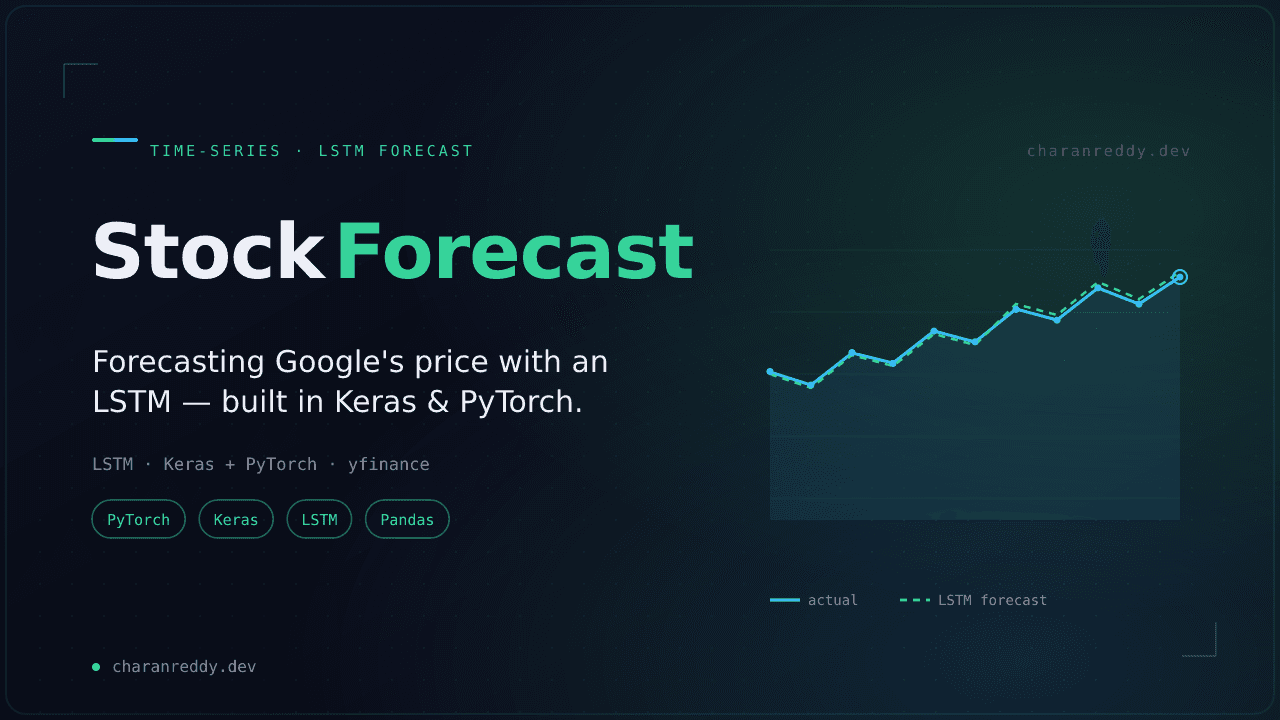
Prices were scaled with MinMaxScaler and enriched with moving averages and daily returns. I built matched LSTM models in Keras and PyTorch, used dropout and early stopping to fight overfitting, then compared them on identical splits with line and candlestick visualizations — to sanity-check predictions rather than trust a single loss number.
Outcome
Both models tracked the broad trend reasonably on unseen data, but the real payoff was intuition: I came away understanding why naive price prediction is so seductive and so misleading, and how much of "good results" in time-series is really data leakage wearing a disguise.
What I'd do differently
Predicting raw price was the wrong target — it makes a lagged copy look brilliant. I'd predict returns instead of price, use walk-forward validation rather than a single split, and judge it on directional accuracy and a trading-style backtest, not RMSE on a normalized chart.