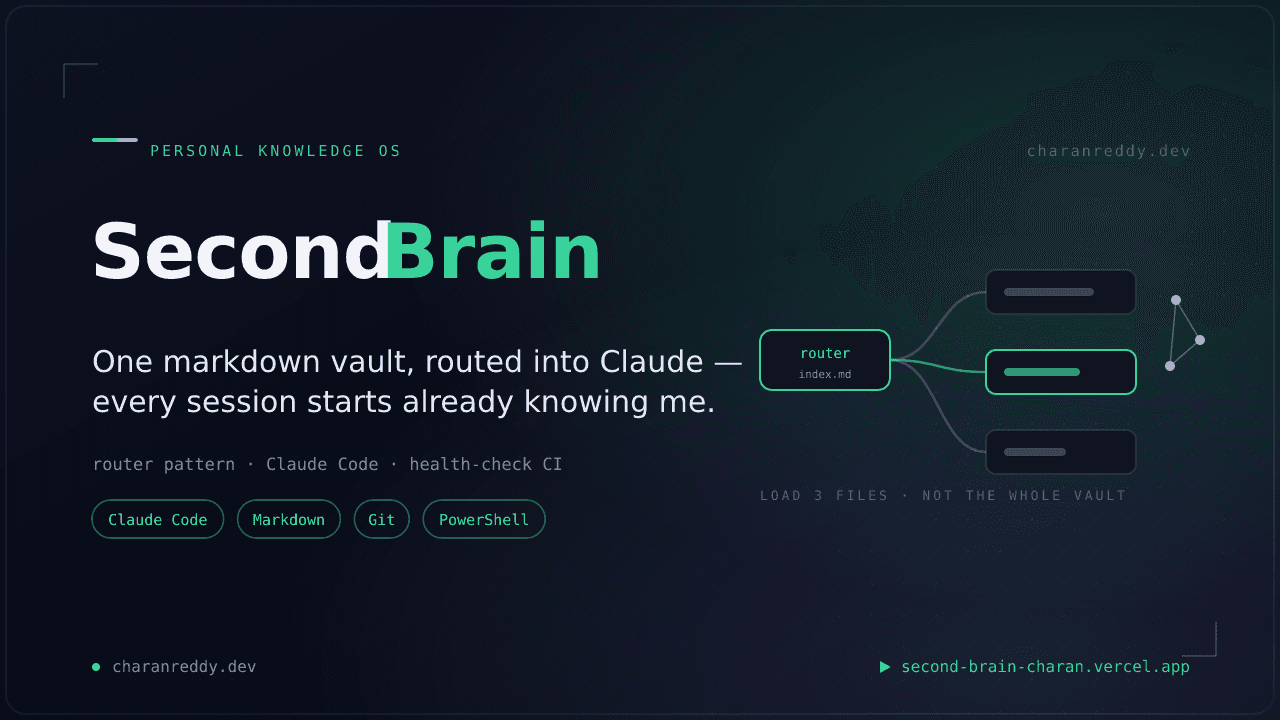
Second Brain: A Personal Knowledge OS for AI Sessions
Overview
AI models are brilliant and amnesiac: every session opens with the same monologue — who I am, what I'm building, what I decided last week — before any real work starts. The obvious fix, one giant CONTEXT.md pasted everywhere, made the agent worse: slower, vaguer, skimming my life like a textbook the night before an exam. Second Brain fixes the actual problem, which turned out to be context delivery, not note-taking — a router that maps tasks to files and a write-back loop that keeps the vault current.
Tech Stack
Challenges
- A single huge context file makes the agent slower and vaguer, not smarter.
- Keeping evergreen facts and time-stamped events from bleeding into each other and going stale.
- Making sure the agent actually writes back what it learned instead of forgetting it next session.
- Detecting when the knowledge base is silently lying — stale, over-budget, or full of broken links.
Solution
A router, not a search engine: the agent reads one ~90-line index that maps tasks to files, then loads only the two or three files a task needs. Two kinds of truth never mix — evergreen facts live in line-capped _context.md files patched in place, events live in append-only dated logs — which keeps retrieval cheap and answers current. Every meaningful session ends with /checkpoint: decisions appended, evergreen facts patched, the focus file rewritten. A ~120-line PowerShell health check enforces frontmatter, line budgets, 30-day staleness and broken-link detection, exiting non-zero when the brain is lying — CI for your life.
Outcome
Every AI session now starts from context instead of a cold introduction, loading only what a task needs. The public showcase site tells that story with a zero-dependency front end — three static pages, one stylesheet, one small JS file — including a hero terminal that replays a real Claude Code session (route → read 3 files → work → /checkpoint) character by character, accessible by construction and responsive down to 360px. The vault itself stays private; it's literally my brain.
What I'd do differently
The lesson that reframed the project: the bottleneck was never storage, it was delivery — a memory system without an update loop is a diary you stop writing in. The health-check-that-exits-non-zero is the DRDO instinct again: a system that fails quietly is the dangerous kind, so make it fail loudly.