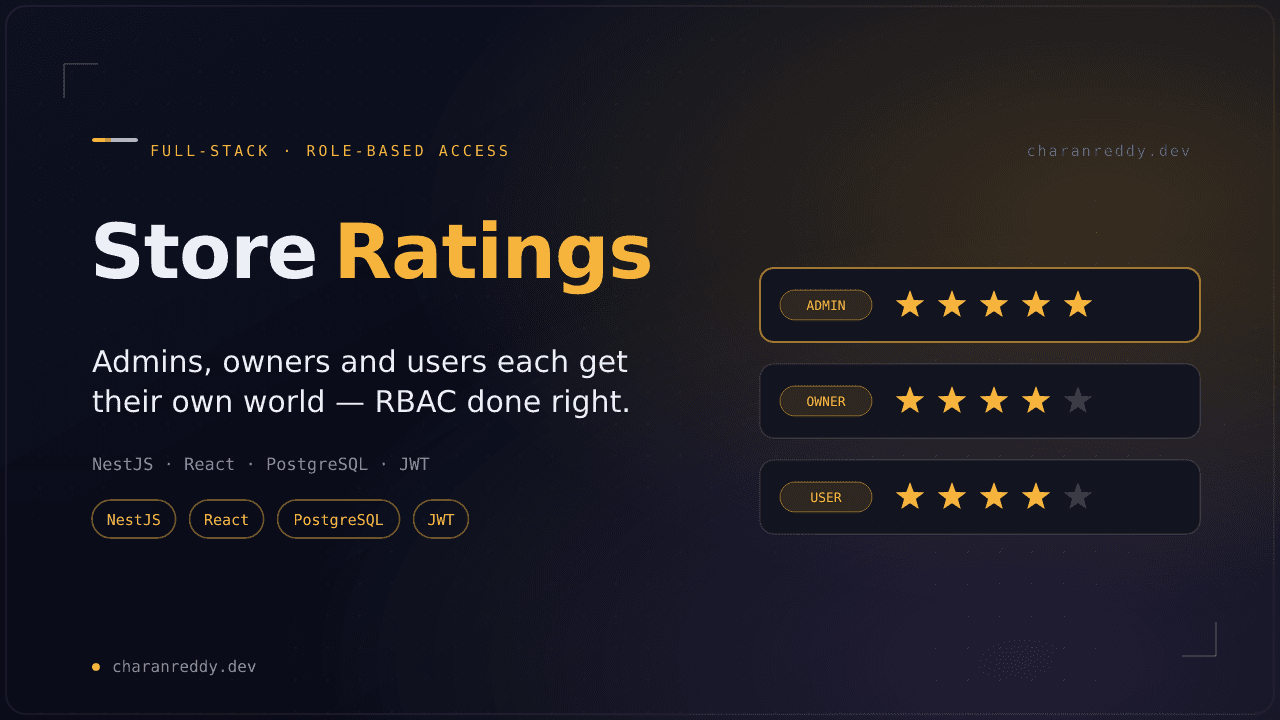
Store Rating System: Full-Stack Web Application
Overview
This is my "build it like it's real" project. Store Rating System is a full-stack app where three roles — System Administrator, Store Owner, and Normal User — each get tailored dashboards and permissions, backed by proper authentication, a relational schema, and live rating aggregation. The point was to practice the things tutorials skip: access control, data integrity, and architecture that survives growth.
Tech Stack
Challenges
- Implementing secure role-based authentication and authorization across three distinct user types.
- Designing a relational schema that cleanly models users, stores, and ratings together.
- Giving each role a distinct interface while keeping one coherent design language.
- Computing accurate, real-time rating aggregations as reviews come in.
- Enforcing thorough validation and data integrity end to end.
Solution
A NestJS backend handles JWT auth, TypeORM data access, and class-validator validation, over a schema built around proper relationships, indexing, and constraints. The React + TypeScript front-end uses protected routes and context-based state to give each role its own dashboard. The architecture is deliberately modular — separated concerns, documented, and configured for production rather than a demo.
Outcome
The result is a genuinely production-shaped application: full CRUD, filtering and search, real-time dashboard analytics, and secure multi-role management, built with the workflow and rigor of a real codebase. It's the project I point to when someone asks whether I can build software, not just models.
What I'd do differently
I'd add automated tests from day one rather than retrofitting them — role-based access is exactly the kind of logic that breaks silently. I'd also cache the rating aggregations instead of recomputing them, and add audit logging, which any system with privileged roles really needs.